
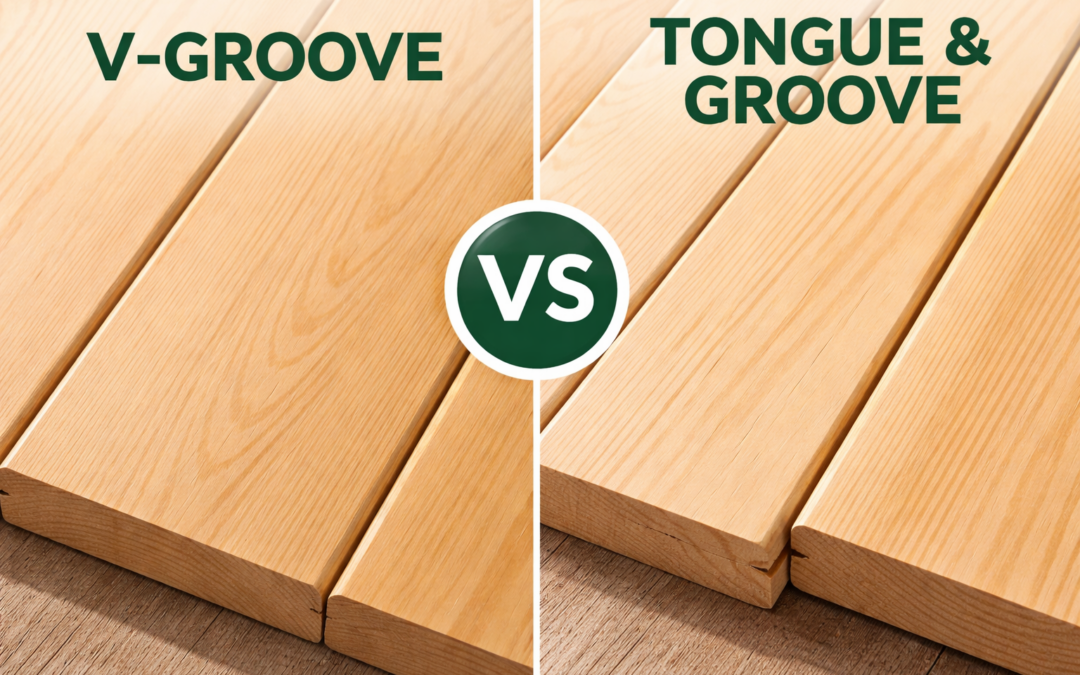
V-Groove vs Tongue and Groove: What the Two Profiles Actually Do
Most comparisons of V-groove and tongue and groove set them up as a choice between two products. That framing is wrong, and it leads buyers to spec the wrong board.
Tongue and groove describes how two boards join along their edges. V-groove describes what the face looks like where that joint lands. They are answers to different questions, which is why nearly every V-groove board on the market is also a tongue and groove board. The V-groove panels we mill in Panguitch join exactly the same way a plain tongue and groove board does — the difference is a bevel cut into the face.
Here is what each term actually specifies, and how to decide what to order.
Tongue and groove is a joint, not a look
A tongue and groove board carries a projecting tongue along one edge and a matching slot along the other. Boards interlock edge to edge, which does three things: it holds adjacent boards in plane, it hides the fastener inside the joint, and it lets the assembly expand and contract as a unit without opening gaps.
That is a structural description. It says nothing about appearance. Plain tongue and groove boards can be square-edged and read as an almost seamless surface, or they can carry a face detail that makes each joint visible.
V-groove is a face profile
V-groove — also written vee groove or V-joint — means both mating edges are chamfered. When the boards come together, the two chamfers form a V-shaped channel running the length of the joint. The channel throws a shadow line, so each board reads as a distinct plank rather than disappearing into a flat field.
The bevel is cosmetic, but it earns its keep. A V-groove face is forgiving: it absorbs small variations in board width and slight seasonal movement inside the shadow line, where a square-edged surface would show them as an uneven seam.
So what is a V-groove tongue and groove board?
It is one board doing both jobs — tongue and groove edges for the joint, a bevelled face for the shadow line. This is the profile most people mean when they say “V-groove,” and it is the standard specification for interior wall and ceiling paneling. The V-groove boards we mill are cut this way as a matter of course.
When a supplier lists a board as V-groove without mentioning the edge, it is almost always tongue and groove. Ask anyway. A V-groove face on a square-edged board exists, but it needs a different fastening approach and behaves differently across a season.
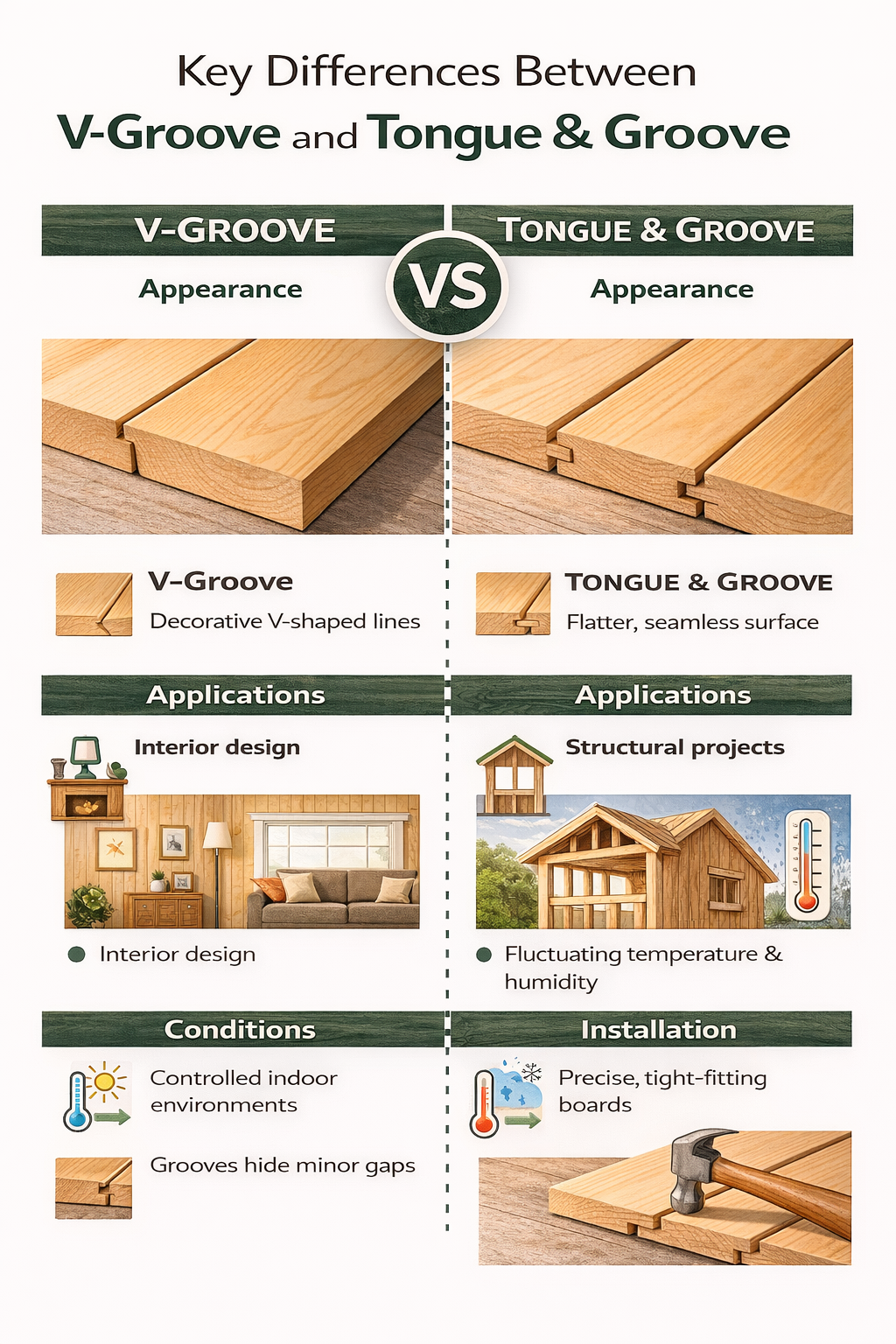
Key differences between V-Groove and Tongue & Groove
Appearance: V-Groove features decorative V-shaped lines, while Tongue & Groove offers a smoother, seamless look.
Strength: V-Groove is mainly decorative; Tongue & Groove is stronger and more structurally stable.
Performance: V-Groove works best indoors; Tongue & Groove handles temperature and humidity changes better.
Installation: V-Groove is more forgiving; Tongue & Groove requires precision but creates a tighter, longer-lasting fit.
“At Kings Peak Lumber, we don’t just supply wood. We help our customers make the right choice for their projects. Whether it’s the bold, decorative look of V-Groove or the long-lasting strength of Tongue and Groove, we provide guidance, quality lumber, and custom solutions to ensure every project is a success.”
Where V-groove sits among the other profiles
V-groove is one of several face profiles available on a tongue and groove board. The others you will be quoted against:
- Square edge (centre match): no face detail. Boards meet in a tight line for a near-continuous surface. The least forgiving of the four.
- Nickel gap: a deliberate flat-bottomed reveal roughly the width of a nickel. Reads cleaner and more contemporary than V-groove; the flat channel catches more dust.
- Beadboard: a rounded bead along the joint. Traditional and period-appropriate, busier across a large surface.
- V-groove (V-match): the bevelled channel. Sits between square edge and beadboard — visible enough to give a ceiling rhythm, quiet enough not to date the room.
All four use the same tongue and groove joint. Choosing between them is a choice about the face, not about structural performance.
Where each profile gets specified
Ceilings. V-groove is the usual choice. A large flat ceiling in square-edged board reads as a blank expanse; the shadow lines give it direction and scale. This is the single most common use we mill for.
Accent and feature walls. V-groove or nickel gap, depending on whether the room wants warmth or a harder line.
Cabin and lodge interiors. V-groove throughout, usually in a wider board. The profile suits the material and the shadow lines carry across the tall wall heights these buildings tend to have.
Exterior soffits and porch ceilings. Tongue and groove joint is essential here for movement. V-groove face is fine and common, provided the material is properly dried and finished on all faces before installation.
Structural sheathing and decking. Tongue and groove joint, square edge. No face detail needed where the surface will be covered.

The part that matters more than the profile
A V-groove profile is only as good as the board underneath it. Two things decide whether a paneling run installs cleanly:
Moisture content. Interior paneling that arrives wet will shrink after installation and open the joints. Our boards are kiln dried in direct-fire kilns and carry a KDHT stamp, so they reach the site at a stable moisture content rather than equalising on your wall.
Milling consistency. If tongue thickness or board width wanders across a bundle, the V-channels will not line up and the installer loses time selecting boards. Consistent dimension across the run is what makes a V-groove ceiling look milled rather than assembled.
We cut paneling in Douglas Fir and Ponderosa Pine, along with Spruce and White Fir. Ponderosa takes stain evenly and is the common choice for interior work; Douglas Fir is denser and holds an edge better where the paneling will take knocks.
Most Common Asked Questions
Is V-groove the same as tongue and groove?
No, but they are not alternatives either. Tongue and groove is the edge joint; V-groove is a bevelled face profile. Most V-groove boards are tongue and groove boards with a V-groove face.
What is a V-groove panel?
A board with chamfered edges on the face, so adjacent boards form a V-shaped channel at each joint. Used for interior wall and ceiling paneling.
What is the difference between V-groove and nickel gap?
Both create a visible reveal between boards. V-groove produces an angled channel that reads traditional; nickel gap produces a flat-bottomed reveal that reads more contemporary and is slightly more prone to collecting dust.
Can V-groove be used on ceilings?
Yes, and it is the most common use. The shadow lines give a large ceiling surface scale and direction.
Can V-groove be used outdoors?
Yes for soffits and porch ceilings, provided the board is properly dried and finished on all faces before installation. For exposed siding, confirm the species and finish schedule first.
What is V-match?
Another name for the same profile. V-match, V-joint, vee groove and V-groove all describe a bevelled face on a tongue and groove board.
Specifying an order
To quote a paneling run accurately we need four things: nominal size, face profile, species, and total square footage or linear feet. If you are matching existing work, send a photo of the end grain and a measurement across the V-channel — that is usually enough to identify the profile.
If the profile you need is not standard, we cut it. Custom-milled profiles are routine work here, and it is often the fastest way to match a restoration or a specified detail that no stock board covers.
Download Our Brochure
For more information on any of our custom products and services, please check our brochure.
Buying direct
We supply lumber yards and distributors carrying paneling as a stocked line, and contractors and builders buying for a specific job. Either way the board comes off our mill rather than through a distributor, which means you can talk to the person who cut it about the profile you need.
See our V-groove paneling for sizes and options, or call us and we will work the spec out with you.
Share on Social Media